Fly™ – The Replenishable Drinking Vessel
Full hydration for endurance athletes under race conditions
in a comfortable, seamless, and unimpeded manner
PATENTED LIQUID REFRESHMENT
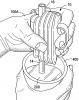
RUN - CLOSE YOUR HAND - OPEN YOUR HAND - YOU NOW HAVE A HANDFUL OF WATER
Fly Racer: Replenishable Drinking Vessel for Athletes
United States
inquiry
The Structure and Operation of the Fly™ – The Replenishable Drinking Vessel
The Fly™ Drinking Vessel was invented by a marathon runner to solve the problems runners experienced using the structures and methods of the prior art. Using the Fly™ Drinking Vessel, a runner can run in full stride through a water stop while knowing he or she will enjoy full hydration without choking or stopping. Runners no longer need to carry their 'fuel' with them since they can now get a container full of fresh beverage at any water stop along a race course without stopping. Runners can run through water stops and drink comfortably without choking. The drinking vessel can be refilled seamlessly during running, and it be carried conveniently and comfortably, whether full or empty. The liquid is available to runners over extended running distances, so one need not gulp down a whole cup of water at once. Most importantly, runners using the Fly™ Drinking Vessel can run faster.
Overview of the Replenishable Drinking VesselThe replenishable drinking vessel is subject to a wide variety of embodiments. However, to provide a broad overview of the drinking vessel, certain preferred embodiments of the broader invention revealed herein are described below and shown in the accompanying drawing figures. These are mere examples of the many possible manifestations of the invention.
Looking more particularly to the drawings, a first preferred embodiment of the replenishable drinking vessel is indicated generally at 10 in FIGS. 1 through 6. There, one can see that the drinking vessel 10 is founded on a compressible bladder 12 with an inlet member 14 for drawing liquid 200 into an open inner volume 26 of the compressible bladder 12 and an outlet member 16 for enabling an exhausting of liquid 200 from the open inner volume 26. In this exemplary structure, the inlet member 14 and the outlet member 16 each comprise a tube with a proximal portion coupled to the compressible bladder 12 and a free distal end.
The drinking vessel 10 can be retained relative to a hand 100 of a user by a retaining means, which in this case comprises a first strap 18 and a second strap 20. The first strap 18 can encircle the palm portion 102 of the user’s hand 100 while the second strap 20 can encircle one or more fingers 106. As the drinking vessel is employed in FIGS. 2 through 5, the second strap 20 encircles one or more forefingers 106. However, the second strap 20 could additionally or alternatively encircle the thumb 104 as is depicted, by way of example, in FIG. 11. Of course, other retaining means are possible and well within the scope of the invention.
As shown in FIG. 6, an inlet valve arrangement 22, which can comprise a one-way valve, can be fluidically associated with the inlet member 14. Additionally, an outlet valve arrangement 24, which can also comprise a one-way valve, can be fluidically associated with the outlet member 16. The inlet and outlet valve arrangements 22 and 24 could be similar or different in structure and function. In the illustrated example, the inlet and outlet valve arrangements 22 and 24 each comprise a simple one-way, flapper-type valve. However, the inlet valve arrangement 22 and, additionally or alternatively, the outlet valve arrangement 24 could alternatively comprise ball check valves as shown in FIG. 9, opposed lip valves, or any other type of valve that might now exist or hereafter be developed.
In an alternative example, the outlet valve arrangement 24 could comprise what is commonly termed a bite valve to enable an actuation of the valve arrangement 24 by a compression thereof by the mouth of the user to permit a withdrawing of liquid 200 from within the open inner volume 26 of the compressible bladder 12. One of the many possible examples of such an embodiment of the outlet valve arrangement 24 is shown in FIG. 6A where a slit 25 is disposed in an end cap portion 27 of the outlet member 16. With this, a user could simply bite on the end cap portion 27 of the outlet member 16 thereby to induce the normally closed slit 25 to an open configuration to allow liquid to pass therethrough.
Certain embodiments of the drinking vessel 10 can additionally incorporate a sponge element 40. Under such a construction, a user can soak the sponge element 40 with water and use the same to clean and cool his or her body while exercising. The sponge element 40 can be retained relative to substantially any component of the drinking vessel 10. In FIG. 3, the sponge element 40 is fixed to the bladder 12. The sponge element 40 can be permanently attached to the remainder of the drinking vessel 10, or the sponge element 40 can be removably attached, such as by a hook and loop combination or any other suitable means.
As will be described more fully below, the drinking vessel 10 could initially be provided in an empty condition to be filled by the user. Alternatively, the drinking vessel 10 could be provided to users with an initial volume of liquid 200 retained in the open inner volume 26. In either case, the open inner volume 26 can be readily filled and refilled with liquid 200 simply by at least partially compressing the bladder 12 to a compressed configuration as is shown, for example, in FIG. 4, disposing the inlet member 14 at least partially into a volume of liquid 200, and decompressing the bladder 12 to an open, non-compressed configuration as is shown, for example, in FIGS. 2 and 3.
As FIG. 12 shows, the bladder 12 could incorporate a skeleton structure 42 for assisting the drinking vessel 10 in maintaining its overall shape. Where included, such a skeleton structure 42 could pursue a variety of constructions. In certain cases, the skeleton structure 12 could be spring loaded to bias the bladder to a given condition, such as to a compressed configuration or to a decompressed configuration.
It will be appreciated, of course, that the bladder 12 could be compressed before, after, and/or while inlet member 14 is inserted into the volume of liquid 200. In any case, as the bladder 12 is decompressed, liquid 200 will be drawn into the open inner volume 26 through the inlet member 14. This intake of liquid 200 will be facilitated by the combined effects of the inlet valve arrangement 22, which will allow liquid to pass into the open inner volume 26, and the outlet valve arrangement 24, which will close to induce a sufficient pressure differential between the open inner volume 26 and the environment.
Advantageously, this filling of the open inner volume 26 can be carried out under substantially any conditions. By way of example, a runner participating in a road race can fill or refill the open inner volume 26 of the drinking vessel 10 with substantially no hindrance to the runner’s race progress. As one can perceive from FIG. 1 and, in a closer depiction, FIG. 7, a runner 600 retaining an embodiment of the drinking vessel 10 relative to a first hand 100A can grab a cup 400 containing a volume of liquid 200, such as water or an energy drink, with his or her second hand 100B. Next, the runner 600 can insert the inlet member 14 into the cup 400 and draw the liquid 200 into the open inner volume by decompressing the bladder 12. The runner 600 can then discard the cup 400 while having a volume of liquid 200 now readily accessible.
With the volume of liquid 200 retained in the open inner volume 26, the runner 600 can drink liquid 200 from within the open inner volume 26 through the outlet member 16 by squeezing the bladder 12 and, additionally or alternatively, by creating suction with his or her mouth. Advantageously, the runner 600 can drink the liquid at his or her own pace, whether immediately or over a given distance, without a risk of choking, spilling, or any of the other notable disadvantages attributable to the prior art. In certain embodiments of the invention, a clip or the like (not shown) could be provided on the drinking vessel 10 to enable the drinking vessel 10 to be retained relative to a user’s clothing or the like when not in use.
Of course, the invention is far broader than the embodiment described above. For example, a further variation is depicted in FIG. 8. There, the drinking vessel 10 again has a bladder 12 for retaining a volume of water, an inlet member 14 for enabling a drawing of liquid 200 into an open inner volume 26 of the bladder 12, and an outlet member 16 for enabling a user to drink liquid from the drinking vessel 10. In this embodiment, however, the drinking vessel 10 incorporates a pocket 28. The pocket 28 can be disposed in a central portion of the bladder 12 such that it would be surrounded by liquid 200 retained within the open inner volume 26. Alternatively, the pocket 28 can simply be disposed within or adjacent to a sidewall of the bladder 12.
In any case, the pocket 28 can be particularly sized and shaped for receiving and retaining a packet 300 of any one of the many types of energy gels and supplements that are available to endurance athletes. Advantageously, where the pocket 28 is provided with thin walls, the liquid 200 and the packet 300 can be maintained in substantially direct thermal contact. With this, not only can an energy supplement packet 300 be readily retained relative to the drinking vessel 10, but also the energy supplement packet 300 and the volume of liquid 200 can assist in maintaining one another in a desired temperature condition. For example, under one use of the invention, a frozen packet 300 of supplement material can be inserted into the pocket 28 such that the liquid 200 and the packet 300 will cooperate to maintain both volumes in a cool temperature condition. When the runner seeks to consume the contents of the packet 300, the packet 300 can be slipped from within the pocket 28 and a tab 304 can be separated from a body portion 302 by use of perforations, a notch 306, or any other suitable means.
Looking to FIG. 9, a variation of the inlet portion of the drinking vessel 10 is shown. There, the inlet valve arrangement 22 takes the form of a ball check valve wherein a ball 30 is retained relative to a ball seat 32. With this, the inlet valve arrangement 22 can prevent the passage of liquid when the ball 30 is seated relative to the ball seat 32 but can allow the passage of liquid by a displacement of the ball 30. The embodiment of FIG. 9 additionally varies in that the inlet member 14 is removable and replaceable relative to the bladder 12 by a threaded member 34 retained relative to the bladder 12 in combination with a threaded portion 36 on the inlet member 14. With this, the drinking vessel 10 can be employed without the inlet member 14 by a selective removal thereof as might be desirable where the user expects to use the drinking vessel 10 without replenishing its contents or where the user might seek to refill the open inner volume 26 by placing the bottom of the bladder 12 directly into a volume of liquid.
FIG. 10 shows still another embodiment of the drinking vessel 10. There, the drinking vessel 10 again has a bladder 12, an inlet member 14, and an outlet member 16. In this case, however, the bladder 12 takes the form of a flexible bottle structure, which can include a cap 38. The outlet member 16 can comprise a straw member, which can be rigid or flexible, straight or articulated.
Material selection in relation to the drinking vessel 10 can have great import relative to its nature and purpose. In certain embodiments, the bladder 12 can be formed from a thin film. One skilled in the art will be aware of a number of possible thin films that could be employed. Furthermore, suitable thin films may be developed subsequent to the preparation of the present disclosure. All such thin films should be considered to be within the scope of the invention. Among the presently contemplated thin films are polyester films, such as those commonly sold under the mark MYLAR; metal foils, which could be lined with one or more plies of polymeric material for strength and durability; multi-ply films; or any other suitable thin films. Other components of the drinking vessel 10, such as the first and second straps 18 and 20 and other portions of the drinking vessel 10, could be formed from similar or different materials. The inlet and outlet members 14 and 16 in such a construction can be formed of simple straw-like members of plastic or the like.
It will be appreciated that such embodiments of the drinking vessel 10 could likely be manufactured at relatively little expense such that they could be designed to be essentially disposable, such as after a single race or use or after a limited number of races or other uses. Under such a construction, it could be practicable for a race organizer or one or more race sponsors to provide some or all runners in a road race with a complimentary drinking vessel 10 to be used during the race. The drinking vessel 10 could be provided in an empty condition to be filled prior to or during the race. Alternatively, such as where the sponsor is a purveyor of beverages, drinking vessels 10 can be distributed pre-filled with the race sponsor’s beverage, possibly while bearing the sponsor’s trademark or the like.
Whether designed to be disposable or not, such thin film drinking vessels 10 are particularly advantageous for the further reason that they can be made extremely light in weight, which is, of course, quite important to a runner. Indeed, with a drinking bladder 12 and possibly first and second straps 18 and 20 formed of thin film material, an empty drinking vessel 10 would be nearly weightless in a runner’s hand and, therefore, would present substantially no impediment during running or other exercise. Where desirable, a clip or the like could be provided to enable the drinking vessel 10 to be retained relative to a runner’s clothing during periods of non-use.
Alternative constructions of the drinking vessel 10 can be crafted to enable repeated usage such that a runner or other user can use the drinking vessel 10 during multiple training runs, races, and further situations where replenishable liquid refreshment would be desirable. Such a drinking vessel 10 can, by way of example, have a compressible bladder 12 formed from one or more layers of polymeric material, such as rubber, from a fabric material, or any other material or combination of layers or types of material that is durable and liquid tight. The inlet and outlet members 14 and 16 in such an embodiment can be rigid or flexible tubes of, for example, rubber, plastic, or any other suitable material.
It will again be appreciated that the present invention has been shown and described with reference to certain preferred embodiments that merely exemplify the broader invention revealed herein. Certainly those skilled in the art can conceive of alternative embodiments. For instance, those with the major features of the invention in mind could craft embodiments that incorporate those major features while not incorporating all of the features included in the preferred embodiments. Each such embodiment shall be considered to be within the scope of the present invention.
Objectives Met by the Replenishable Drinking Vessel
It will be appreciated, therefore, that the replenishable drinking vessel 10 overcomes the disadvantages from which the prior art has suffered. The replenishable drinking vessel 10 provides easily consumed, readily replenished, and conveniently accessible liquid refreshment to endurance athletes under widely varied conditions. By enabling an athlete to draw liquid from a cup 400 or the like simply by opening his or her hand while in full running stride, the drinking vessel 10 enables athletes to continue through water stops essentially unimpeded while still obtaining full and proper hydration. Because athletes can draw liquid from a straw-like output member 16, the drinking vessel allows athletes to drink comfortably without choking. Since the drinking vessel 10 can be rendered extremely lightweight, particularly when empty, it can be carried conveniently and comfortably. Even further still, because the drinking vessel 10 can be carried without spilling or other disadvantages, athletes need not gulp down liquid immediately and instead have liquid available over extended distances. Together, the foregoing advantages provided by the replenishable drinking vessel 10 of the present invention can enable athletes to run faster and more comfortably.
U.S. Patent No. 7,819,293, other patents pending. Copyright 2010 Fly Racer: Replenishable Drinking Vessel for Athletes. All rights reserved.
Fly Racer: Replenishable Drinking Vessel for Athletes
United States
inquiry